

Dora, an NHS therapist | 20 coaching sessions over 19 months
“I was worried coaching would be too directive but Victoria balanced emotional validation, with suggestions and experiments. She has genuinely dispelled some myths and rules I didn’t know I was working to, and she has helped give me the confidence to assert and uphold my needs with less shame.”
At a glance
Where Dora started: A dedicated therapist quietly masking how hard organisation felt - while also facing months of not knowing whether her Trust's funding, and her job, would continue
What we worked on: Her energy, her systems, the way she spoke to herself, and asking for what she needs
What changed: Systems she trusts, adjustments she asked for herself, and her creative writing back
Who paid: Her NHS Trust (I set up as a supplier) and Access to Work, so coaching could run beyond the usual 12 months
Where Dora started
Dora is a therapist with ADHD, working in a busy, highly pressured NHS service. When we met, she was also starting to wonder whether she might be autistic.
From the outside, she was doing brilliantly. She juggled a full caseload, supervised others and picked up all the extra jobs that come with being the reliable one. Colleagues saw someone capable and dependable. Inside, Dora felt like she was "winging it".
She'd been masking for years - quietly working harder and longer, so no one would see how much effort organisation took. Everyday tasks used far more energy than they should, and keeping everything in her head was exhausting.
I know that mental load well. Between running a business, juggling clients and having a life outside work, my head is rarely quiet (and there's usually a random song on repeat, for good measure!).
When something slipped - as it does, because we're human - her inner critic was quick to jump in: "Why wouldn't you have thought of that?"
I see this so often in people who care for others for a living. They give endless kindness to everyone else, and have very little left over for themselves.
What Dora wanted was simple: enough structure to feel organised, and enough flexibility for days when plans changed or a therapy session was particularly intense.
How we worked together
Dora had worried coaching would mean being told what to do. In reality, my sessions are a blend of questions, space to be heard and suggestions to try - and Dora always decided what to experiment with. As a therapist, she already knew plenty of strategies, and she was very self-aware. What she needed was space to work out which ones suited her brain, her job and her life outside work.
It might be called Access to Work, but we don't stop being who we are when we sit down at our desks.
So between sessions, she'd pick a strategy to try, see how it went and bring back what she'd noticed. Having lots of options felt freeing. On a low-energy day, she could simply reach for a different tool instead of feeling like she'd failed.
Early on, Dora noticed the words she used about herself: "rigid", "efficient", "winging it". Over time, I started to notice patterns behind them, like unwritten rules she didn’t know she was working to..
She cared deeply about fairness and equity (something I often see in clients with ADHD), so she tried to accommodate everyone. That meant offering therapy clients and friends lots of options for appointments and catch-ups, then chasing replies and creating more admin for herself. She also tended to rehearse worst-case scenarios days in advance.
With Dora's permission, I shared what I was noticing. Then she explored which strategies might help her make the changes she wanted.
All of this happened alongside months of not knowing whether her service would continue, a house move and a phased return to work. That's a lot for anyone.
On the harder days, one model that really helped was the circle of control. It sorts everything going on into three areas: what you can control, what you can influence and what's outside your control. When life feels uncertain, it shows you where your time and energy will actually make a difference.
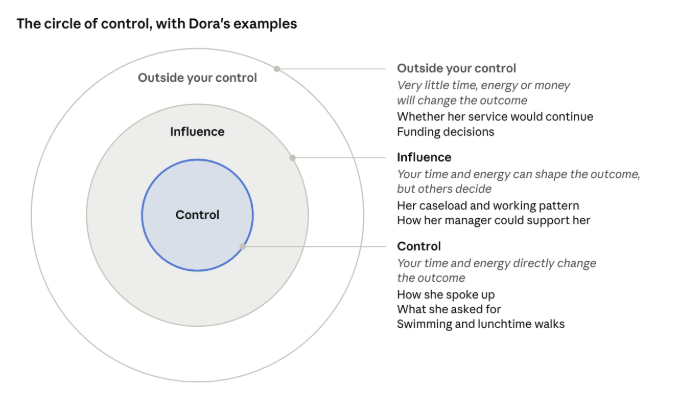
Dora put her energy into the inner two circles. She talked openly with her manager, and protected her recovery with swimming and lunchtime walks. The bigger picture was still uncertain, but she felt steadier.
The biggest shift: turning her curiosity towards herself
With her therapy clients, Dora was naturally curious and kind. With herself, the inner critic took over.
Noticing that difference changed everything. Instead of "Why wouldn't you have thought of that?", she started asking herself, "What happened there, and what would help next time?" A mistake became something to learn from, rather than proof she wasn't good enough.
One moment has really stayed with me. Dora told me she thought she was doing the least work on her team. Then she looked at her diary, full of completed session notes, and realised the story she'd been telling herself didn't match the facts. She'd simply never stopped to notice how much she was achieving.
I was so very glad she saw that for herself.
What Dora built
Protecting her energy when her diary isn't hers
You'll often hear "plan your ideal week around your energy" or "try time blocking". Great advice - if you're in charge of your own diary. In an NHS service with a fixed caseload, Dora wasn't.
So she focused on the parts she could shape. She kept the first slot of the day clear, saved the trickier admin for when she had the most energy, and asked for more time between therapy clients when her caseload was reviewed. Small changes, but they meant her energy lasted further into the week.
A diary she can rely on
In an ideal world, all of Dora's therapy appointments would live in one calendar. But NHS IT and security rules meant her systems couldn't be merged.
So she found another way. She marked herself as busy across every system, mapped out the week on a visual calendar and checked tomorrow's plans the evening before. Now there are fewer surprises and double bookings (nobody's favourite kind of plot twist), and she starts each day knowing what's coming.
Working with her cycle, not against it
You'll often hear that you should aim for the same output every day. Hormones have other ideas.
Dora was already tracking her cycle, so we built on what she'd noticed. We talked about how hormones affect the body and brain throughout the menstrual cycle, and how energy, focus, and mood can shift week to week. Now, when a lower-energy week comes round, she knows why - and she offers herself kindness instead of criticism.
Everyday tools
Access to Work calls these coping strategies. Here are some of the options we explored together - Dora tried them out and kept what suited her:
Admin with less friction - voice-to-text, working across two screens, a tool that estimates how long tasks will take and text shortcuts for common replies, so admin takes less time and energy. Some tools that help other clients, like AI assistants, weren't allowed under NHS IT rules, so she stuck with what was approved.
Evidence she's doing well - a daily "three good things" habit, a folder of kind feedback, and colour-coding completed session notes so she can see her progress at a glance.
A confident alter ego - I love Todd Herman's alter ego idea. Picture someone, real or fictional, who has the quality you need, then ask how they'd act, what they'd say, and how they'd carry themselves. It amplifies qualities you already have. For Dora, that meant asking, "What would a more confident version of me do?" when she needed to say no or stick to a decision.
Not every strategy stuck - and that's a-okay. Everything was an experiment. Some things worked for a while and then stopped, and that became data rather than failure. Now Dora has a mental toolkit that works with her brain, her energy and her hormones. When one strategy stops working, she simply reaches for another.
What changed
Hid how much effort organisation took → Tells her manager what she needs with less shame and has asked for changes to her caseload and working pattern, so her work fits how she works best
A harsh inner critic asking "Why wouldn't you have thought of that?" → Meets mistakes with curiosity, deals with them and moves on, so one slip no longer takes over her day
Everyday tasks drained her, and busy weeks left her exhausted → Protects what she can within a fixed caseload - a clear start to the day, admin matched to her energy and asking for more space between therapy clients
Spent days rehearsing social plans and worrying about what might go wrong → Hosts family, and says no to plans with friends when she needs to - without days of dread
Offered lots of possible times, then chased replies → Offers two held times and welcomes alternatives, so bookings are confirmed sooner, with far less admin
A four-year creative stall → Writing again outside work
She also spoke up when a colleague was treated unfairly. She did it calmly, and in a way that gave others the confidence to speak up too.
She asked for adjustments that suit her, and eased back into work gradually through a phased return. Along the way, she completed her clinical supervisor training. And those diary tips? She now shares them with friends.
The turning point was Dora offering herself the same curiosity and care she gives her therapy clients. She knows what she needs to do her best work now - and instead of masking, she asks for it.
Hearing Dora tell me she felt creative again, for the first time in four years, has been one of the real joys of this work.
Recognise yourself in Dora?
If you work in the NHS, or support other people for a living, these questions might be worth sitting with:
How do you speak to someone you support when they make a mistake - and how do you speak to yourself?
Where are you quietly putting in twice the effort just to keep up?
What adjustment would make the biggest difference - and who could you ask?
If you're a manager or in HR supporting someone like Dora, your organisation can arrange and pay for coaching, with or without Access to Work.
If you saw yourself in any of these questions and would like to learn more about working with a coach, I'd love to hear from you. Feel free to book a free discovery call.
About this case study
Dora read and approved this case study before it was shared, and it's published with her permission. To protect her privacy, I've changed her name and left out anything that could identify her. Her story will never appear in paid adverts, and she's welcome to ask me to take it down at any time. Every client's coaching is shaped around them, so no two stories look quite the same.