

Saffron, artist | 3 sessions over six months
Victoria is highly experienced at supporting people like me and as such, I felt comfortable and confident in her expertise from the get go. She quickly adapted her approach to meet my needs and spent time working for me in between sessions in order to provide focussed 121 support, effectively maximizing the 3 hours. She provided clarity, identified patterns and offered many practical strategies for me to implement, which really helped me to grow during an intense and transitional time in my career and personal life. Her efficient notes and actionable next steps were really useful to have to refer to and she was also very flexible around my changing schedule. The sessions with her have been so valuable, I’m excited for more in the future.
At a glance
Where Saffron started: Burnt out after every deadline, resisting bed, and sure she could rest once the to-do list was clear.
What we worked on: Bedtime, pacing and realistic plans - then money and connection when life shifted.
What changed: Rest and joy went on the plan, her days got more realistic, and she had a clear order for what to tackle next.
Who paid: Access to Work - just three sessions over six months.
Where Saffron started
From the outside, Saffron came across as hugely capable and ambitious. She's an artist with a real eye for detail, brilliant at planning big projects and skilled at fine, precise making. She handles every stage of her work herself - planning, making, admin, sales, events and marketing. Every piece involves a lot of labour, and a lot of decisions.
Inside, it was a different story. She'd push hard to a deadline, then take weeks to recover - and when we first met, she still hadn't. She described herself as a "perfectionist and workaholic". Evenings were the hardest part, because she resisted going to bed even when she was exhausted.
Underneath it all was a belief she put really clearly: if she could just clear the to-do list, then she could rest. The list, of course, never ended.
I'm the opposite - far more likely to be in bed early and up at 3am to clear the urgent stuff - but I know how loud that never-ending list can get.
How we worked together
Saffron knew exactly what she wanted from coaching. She was already working with another practitioner on the roots of her perfectionism, so she asked me to focus on the practical side - and to be proactive and directive about it. "Directive, pragmatic, to the point" was how she put it.
We only had three sessions - the fewest I've ever had with a client. So we used each one well. Saffron did a lot of the work in between, trying things out and sending me updates on what was and wasn't working.
With her permission, I shared the patterns I noticed and my ideas more directly than I usually would, and Saffron decided what to try. Everything was an experiment, and if something didn't stick, that was useful data rather than failure.
Part way through, things changed. Money became her most pressing worry, and Saffron wanted more connection in her life. So we followed what mattered most to her.
The biggest shift
The biggest shift was Saffron putting everything into her plans - not just work, but meals, rest, travel and self-care.
It sounds small, but once it was all written down, she could see how long things really took. Her plans became more realistic, she was on time more often, and rest stopped being a reward she'd only get "once everything's done".
One moment that stayed with me was Saffron's bedtime reminders. She made two pictures for herself:
Zombie Saffron - the tired, grumpy version of her who showed up the next day if she stayed up late
Beautiful, wealthy Saffron - who she'd be if she went to bed on time, and who she was working towards
It made a tricky habit feel a lot lighter - and it was very her.
What Saffron built
Bedtime as a dial, not a rule
You'll often hear that everyone needs eight hours. Great advice - until you've just finished a huge project and need far more than that.
Saffron noticed that after a big push, a really early night with 12 hours lying down was deeply restorative. When life felt more balanced, eight was enough. So we stopped treating sleep as one fixed number and started treating it like a dial she could turn up or down.
She also gave bedtime its own hour - bathroom, face, phone on charge - so getting ready for bed wasn't one more thing squeezed in at midnight.
Good, better and best days
Planning ideal days is super lovely in theory, but for Saffron, ideal days were rare, and falling short of them just added to the feeling of never quite getting enough done.
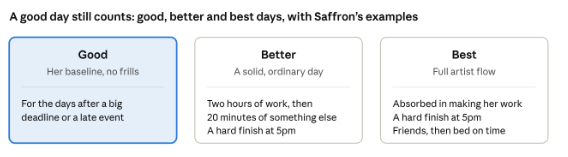
So she mapped out three versions instead. Good days were her baseline - a perfectly decent day with the essentials and no frills, for when her energy was lower or she hadn't slept well. Better days were solid, ordinary days with a steady rhythm, like two hours of work then 20 minutes of something else, with a hard finish. Best days were full artist flow - rested, well and absorbed in making her work, but still with a hard finish at 5pm, an evening with friends and bed at a decent hour. Rare, but still worth picturing.
The idea behind it is that every kind of day counts, and today's output stands on its own, whatever yesterday looked like.
I once read that you give 100% every day - it's just that your 100% feels different from one day to the next. I love that, because it's so true.
Some of my autistic clients describe this with spoon theory, where each spoon is a unit of energy - an idea first used by Christine Miserandino to explain life with chronic illness. Others think of it as pennies. Either way, some days you wake up with fewer spoons or pennies to spend, and some days the same task costs more than it did the day before.
Protecting the day after
Evening events matter to Saffron, for her work and for seeing people. But they used to leave her too tired to do much the next day.
Now, when she books an evening event, she blocks out the following morning and keeps the next evening free where she can. She did the same with deadlines, looking at what the weeks after a big project actually needed, rather than starting the next one straight away.
If you manage a team, this is worth knowing. A big event or deadline can leave someone with very little energy the next day, and a quieter morning afterwards often helps more than pushing on.
Making less, charging more
Time tracking gets recommended a lot, so it was one of Saffron's first experiments - but it didn't work for her. Her work is intricate and meticulous, and a lot of it can't be neatly logged - a single detail might take hours of careful handwork, and much of the thinking and problem-solving happens in between. Many things took longer than expected, so the numbers mostly felt like they told her she was behind. For someone who already felt she never got enough done, those numbers just gave her another reason to be hard on herself.
So she tried something else. She worked out what her life actually costs - from just getting by, to comfortable, to her dream - and compared that with how many hours she wants to work. Her conclusion was simple: make less, charge more.
Connection that doesn't drain her
When money's tight and socialising already takes a lot of energy, seeing people is often the first thing to go.
So we looked at ways to be with people that didn't cost much money or energy:
One-to-one micro-dates - a 45-minute walk in the park or a cup of tea at a friend's house, with a clear start and end.
Body doubling - working quietly alongside an artist friend, no talking required.
Selling skills - offering her eye for styling or decluttering as a paid service, so she could get out of the house, meet people and feel connected while being paid well.
When Saffron reconnected with friends, she felt noticeably better. She also started reaching out to people for coffees and booking in art events, so being with people became part of the plan, right alongside her work.
Do now, pause, let go
By our last session, Saffron had a long list of ways she might earn more, and trying them all at the same time was overwhelming her. She asked for clear, directive guidance, so I gave it, and we sorted her ideas into three categories:
Do now - quick, local options that could bring money in soon
Pause for 30 days - good ideas with longer lead times, to revisit later
Let go - anything too risky, or that needed money she didn't have yet
Saffron decided what to keep. Having a clear order meant she could put her energy into a few things properly, rather than spreading it across everything.
Everyday tools
Access to Work calls these coping strategies. Here are some of the ideas we talked through together. Not all of them suited the way Saffron's brain works - she tried them out, kept the ones that helped and happily left the rest:
Planning apps like Tiimo, Forest for focus, and a talking clock app, so she could keep track of time without constantly checking
A phone-blocking device, so there was a bit of friction between her and her phone at bedtime
A printed habit tracker, so she didn't need her phone to check in
A "dopamine menu" of five-minute joys - a walk outside, dancing, five minutes on the guitar, laughing at memes with friends - so she had quick ways to feel good that had nothing to do with her to-do list
Overnight oats, a stocked freezer and ready-cooked dinners for busy weeks, so eating well didn't depend on having energy left at the end of the day
Laying clothes out the night before, and keeping a set at the studio to cut down on packing
Bulk-booking train tickets, so she locked in cheaper fares and could plan around fixed travel times
Blocking the morning after evening events, so she had time to recover before getting back to work
Short weekly video messages to friends, so she could stay in touch even in busy weeks
What changed
Planning only work → planning everything, including rest and self-care, so that her days are realistic and she's on time more often
Pushing through until the list is done → a lighter day midweek, so that she has room to recover between busy stretches
Saying yes out of obligation → doing fewer things she doesn't want to do, so that her energy goes where it matters
Long journeys to the studio → living close by, so that she gets hours back each month and feels less overstimulated
Making as much as possible → making less and charging more, so that her work can support the life she wants
Too many ideas at once → a clear do now, pause, let go list, so that she can focus on a few things properly
Not seeing friends for ages → small, low-cost ways to connect, so that she feels less alone without running out of energy
Saffron's life didn't suddenly become easy. A huge project in the middle of our work left her exhausted, and the money pressures are real.
But she now plans rest, people and her art into the same week, and she knows what to do first when the list gets long again.
I'll admit, being asked to be more direct made me smile. Most people ask me to go gently. Saffron wanted it straight - and then took what I said and made it her own, every single time. Even after an exhausting summer, she kept turning up with her humour, her ideas and a fresh plan. I really loved working with her.
Coaching doesn't always need months. Sometimes a few focused sessions, with space to experiment in between, are enough to make a real difference - which also makes it a manageable investment if you're arranging support for someone in your team.
Recognise yourself in Saffron?
Do you tell yourself you'll rest once everything's done?
Do you, or someone in your team, push hard to a deadline and then need weeks to recover?
Do you have so many ideas that you don't know where to start?
If you're a manager or in HR, you can also arrange and pay for coaching for someone in your team.
If any of this sounds familiar, book a free discovery call and we'll talk about what would help.
Read other client stories here.
About this case study: Saffron read and approved this case study before it was shared, and it's published with her permission. To protect her privacy, I've changed her name and left out anything that could identify her. Her story will never appear in paid adverts, and she's welcome to ask me to take it down at any time. Every client's coaching is shaped around them, so no two stories look quite the same.