

A simple way for neurodivergent minds to sort work worries - for you, and for your team.
It's 3am and your mind is still busy. That email from your manager. The rumour about a restructure. The client who's gone quiet since you sent over your quote.
None of it can be sorted right now, but your brain keeps going anyway. Overthinking, rumination - whatever you call it, it's going over the same thoughts again and again without getting any closer to an answer.
If that sounds familiar, you're not alone. A lot of the people I coach - neurodivergent folk, and those who think they might be - spend a huge amount of mental energy on things they can't actually change. Often that isn't a choice. Whether you're a deep thinker who spots what others miss or you live with anxiety, your brain scans for what might go wrong, and it won't easily let go of a problem it hasn't yet solved.
And if you're perimenopausal, 3am might be when you're wide awake anyway. Changing hormones often disrupt sleep, and many neurodivergent women find their ADHD or autistic traits feel stronger during this time too - so the overthinking can feel louder just when you have less energy to manage it.
I know this one well. I'm an anxious overthinker myself, and a little tool called the circle of control is something I reach for most. It helps me step back, look logically at what's going on and work out what I can do, so I feel like I'm taking back a bit of control. And sometimes I literally have to tell my brain to stop thinking - that's another trick worth saving for later too.
I'd love to tell you there's one magic strategy that switches an overthinking brain off entirely (if only). This article is about something gentler than that. The circle of control helps you notice those thoughts a little sooner and sort them into three areas, so they feel less like a tangle of worries and more like something you can work with.
What is the circle of control?
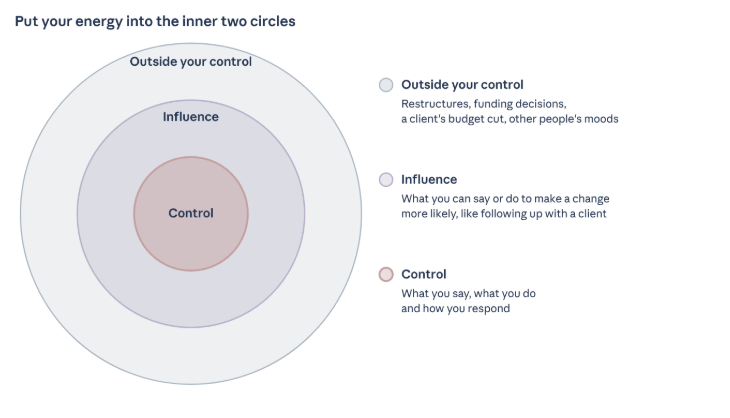
It's based on Stephen Covey's circles of concern and influence, from The 7 Habits of Highly Effective People. My version has three circles, one inside the other.
Why circles? You know, a client once asked me this, and it's a fair question. The smallest circle in the middle is what you can actually control. As you move outwards, you have less and less control. If circles don't work for your brain, a simple list with three headings does the same job.
Control sits in the middle. These are the things that are genuinely yours: what you say, what you do, how you respond and the boundaries you set. At work, that might be asking a question in a meeting or deciding not to check emails after 6pm. If you're self-employed, it includes your prices and the clients you say yes or no to.
Influence is the ring around it. You can't guarantee these things, but you can say or do something to make the change you want more likely. You can't guarantee a good night's sleep, but a wind-down routine helps. At work, you can't guarantee a place on a project or the software you need, but asking improves your chances. If you're self-employed, you can't make a client sign, but your marketing, how you follow up and an easy sign-up process all help.
Outside your control is the outer ring. These are often genuine concerns, and no amount of worrying or action will change them: restructures, funding decisions, a client's budget being cut, other people's moods. That includes how others react. If you experience rejection sensitivity, which is common with ADHD, a client going quiet or a short email from your manager can feel huge. Noticing that their reaction sits outside your control can take some of the sting out of it.
If you're not sure which is which, ask yourself:
Can I decide and act on this myself? That's Control.
Can I say or do something to make the change I want more likely? That's Influence.
Neither? That one sits outside your control.
Here's one example that covers all three: a restructure. The outcome might be out of your hands, but you may be able to ask questions or share your needs, and you can still choose how you respond while you wait. The whole situation will still likely suck, but at least you're focusing your energy on the things you can control, rather than worrying about the stuff you can't.
What it isn't
I want to say this early, because the circle of control sometimes gets used in a way I don't love.
It isn't about pretending everything's fine, or "just accepting" things that are unfair. If something at work isn't right, you're allowed to say so. Asking for adjustments, raising a concern or pushing back on a decision are all in your control. You can't guarantee the outcome, but speaking up makes the change you want more likely - that's your Influence circle at work.
And it won't stop the overthinking altogether. You might decide on Monday that a concern is outside your control and find yourself thinking about it again by Wednesday. That's completely normal. The circles help you notice when it's happening, so you can gently sort that thought, decide what (if any) action to take, and return to the rest of your day.
Why it helps when work feels uncertain
Uncertainty can feel physically uncomfortable. When you can't predict what's coming, your brain may try to prepare for every possibility at once, which is undoubtedly exhausting. Mentally sorting each thought into what you can control, what you can influence and what you can't helps you see where to put your energy.
If you're autistic or find unpredictability a challenge, not knowing what's coming can be especially hard. A rumour about a restructure might take up far more mental energy than the people around you realise.
If you're masking at work - hiding or toning down parts of yourself to fit in - a lot of your energy is already going on reading the room and second-guessing yourself. That leaves less to spare for everything else, so it helps to spend what's left on things you can do something about.
What it looked like for Dora
Dora is an NHS therapist I coached over 19 months (you can read her full story here). For some of that time, she didn't know whether her service would continue. This is what her circle of control looked like:
Outside her control: whether her service would continue, and the funding decisions behind it.
Influence: her caseload, and the support she had from her manager.
Control: how she spoke up, what she asked for, and her swimming and lunchtime walks.
Dora focused on the inner two circles, talking openly with her manager and protecting her energy during her lunchbreaks and time away from work. The bigger picture stayed uncertain for a while, but she felt steadier. The choices were all hers - my role was to give her space to think them through.
How to use the circle of control when you're stuck
You don't need anything fancy. A piece of paper works, get the free workbook here to fill in, or use my free interactive workbook here.
Get it all out of your head. Either list everything on your mind about work, big or small, or pick one concern and break it into parts. It can be messy - nobody else needs to see it. If you have ADHD, this step matters even more. Writing worries down takes them out of your working memory, and seeing them laid out in circles can make them easier to sort than juggling them in your head.
Sort each concern into a circle. If you're not sure where something goes, use the three questions above. Things can move between circles, so something outside your control might turn out to be something you can influence.
Look closely at your Influence circle. Who could you talk to? What could you ask for? What would make that conversation easier - writing your points down first, sending an email instead of asking in a meeting, or taking someone with you?
Pick one thing from your Control circle to try this week. Just one. Think of it as an experiment. If it doesn't work, that's data rather than failure, and you can try something else next week.
Find a way to set down what's outside your control. These concerns are real, and setting them down for a while doesn't mean they don't matter. You could write them down and close the notebook, or notice when your thoughts drift there and gently come back.
In the UK? If you're eligible, Access to Work can fund coaching, whether you're employed or self-employed. My Access to Work guide explains how it works.
Making room for this in your team
As a manager or in HR, you shape a lot of what sits in someone's Influence circle. Small, low-cost changes can make a real difference.
Use the circles as a way in. If someone in your team is struggling or you suspect they might be, you could sketch the circles together, or simply ask what's on their mind and which parts feel within their reach.
Be clear about expectations. There are many unwritten rules in an office environment, so being clear about expectations helps massively. Things like - what does "urgent" mean here? How quickly are people expected to reply? How do you ask for help? Spelling these out takes away a lot of guesswork.
Make adjustments easy to ask for. The simpler it is to ask, the bigger someone's Influence circle becomes. A short form or a regular check-in can help.
Share what you can, when you can. When change is coming, people often worry most about what they don't know. Being as open as you're able to be can help someone feel steadier while they wait.
Ask, then let them lead. Everyone's circles look different. Asking what would help works better than guessing.
If someone in your team would benefit from specialist one-to-one support, employer-funded coaching is one option. You might also find my article on psychological safety at work helpful.
A few questions to take away
For you
Which worries have taken up most of your energy this week, and which circles do they belong in?
What's one thing in your Influence circle you haven't asked for yet?
What's one small experiment you could try this week?
For your team
What expectations might your team be guessing at?
How easy is it for someone to ask for an adjustment or say they're struggling?
When change is coming, how much can you share, and how soon?
Get the free workbook
I’ve made a short workbook so you can try this for yourself. It explains the three circles, gives you space to note what’s on your mind and sort it into each circle, plus a few coaching questions to help you decide what’s next.
You can use it right here on my website, and come back to it whenever you need.
👉 Try the free interactive workbook here.
Prefer something to print? Pop your email in and I’ll send you the PDF version.
👉 Get the free printable workbook here.
What coaching can change
Coaching gives you space to work through what's really getting in the way, then try small changes at work until something sticks. Here's what that has looked like for my clients.
For you:
Rejection sensitivity → an abrupt email or a quiet client stops knocking you off course for days
Executive function → a way of planning, prioritising and starting tasks that fits how your brain works
Leadership → leading in a way that feels like you, without copying the loudest person in the room
Career progression → going for the promotion, pay rise or new role you've been putting off
Boundaries → raising your prices, saying no to draining work and switching off after hours
Masking → spending less energy fitting in, and more on the work you're good at
For your team:
Retaining talented people → an employee who was struggling feels supported enough to stay and grow
Clearer communication → managers and employees agree expectations instead of guessing
Adjustments that work → specific, practical changes based on what the person actually needs
Confidence in meetings → a quieter team member shares ideas in a way that suits them, like written follow-ups
Neurodivergent leaders → people stepping into management with a style that plays to their strengths
Career progression → neurodivergent employees moving up within the company
You decide what we focus on and which ideas to try. Sessions give you processing time, with an optional form beforehand, pauses welcome and notes afterwards. And if your best thinking arrives later (even at 3am), send it over via email or add it to our shared session notes.
Prefer to talk it through?
If you'd like support for yourself, you can read more about one-to-one coaching or book a free discovery call. It's a relaxed chat to see whether coaching is the right fit, with no pressure either way.
If you're arranging support for someone in your team, here's how employer-funded coaching works.
In the UK and using Access to Work? Request an Access to Work quote here.
If you try the workbook, I'd love to hear which circle surprised you most.